What Are the Main Types of Taiwanese Tea?
Taiwan's Tea Research and Extension Station sorts the island's tea into six types. Read this once, and almost any tea name will tell you what it is and where the cup leans.
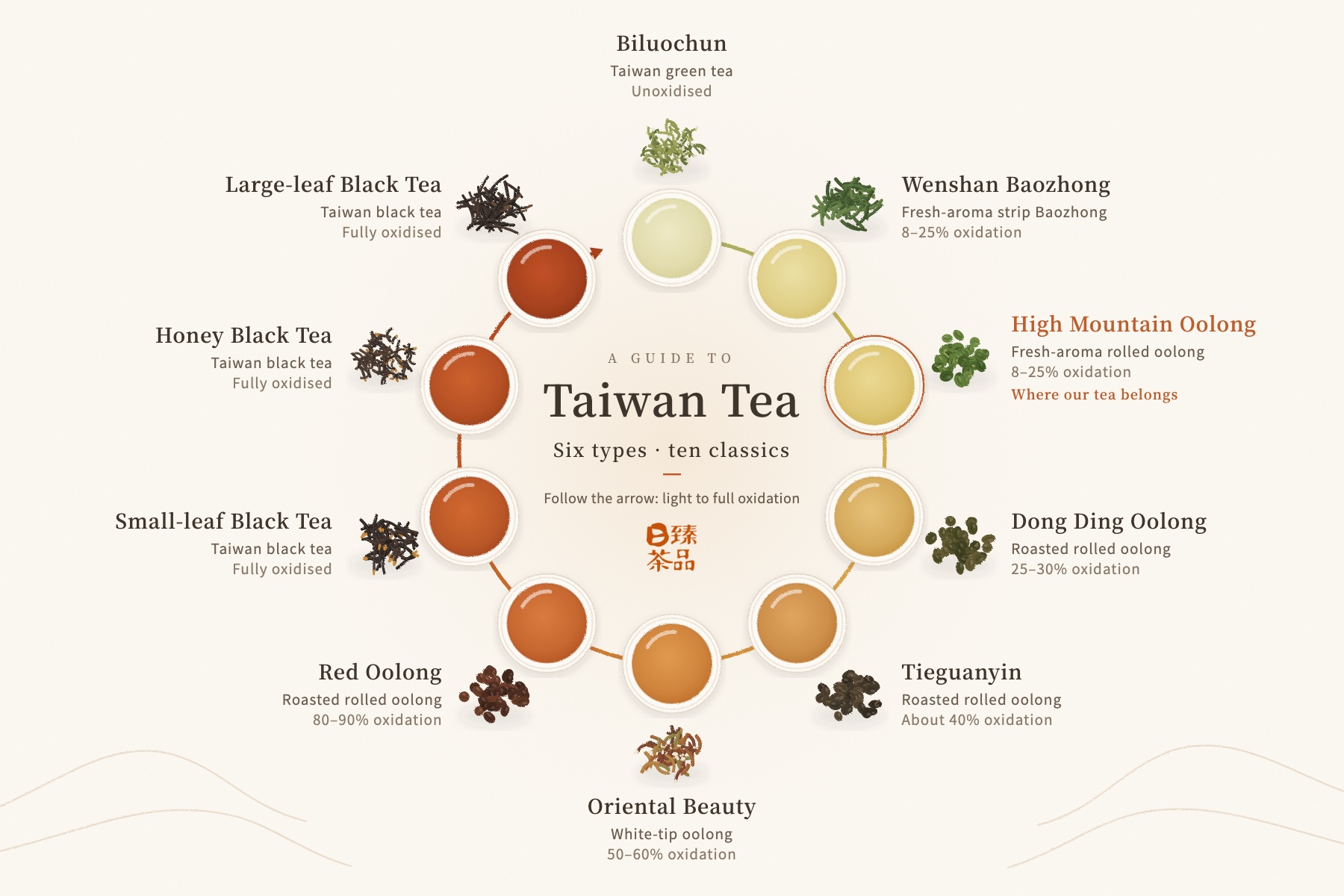
Tea shop labels carry a lot of names: Baozhong, high mountain oolong, Dong Ding, Tieguanyin, Oriental Beauty, honey black… What sets them apart? There is an official answer. The Tea Research and Extension Station sorts Taiwanese tea into six types by shape, oxidation and roast. Those six are all you need.
- Taiwan green tea
- Sanxia Biluochun, Longjing · unoxidised
- Fresh-aroma strip Baozhong
- Wenshan Baozhong · 8–25% oxidation, unroasted
- Fresh-aroma rolled oolong
- High mountain oolong · 8–25%, unroasted or lightly roasted
- Roasted rolled oolong
- Dong Ding 25–30%, Tieguanyin ~40%, Red Oolong 80–90% · roasted
- Oriental Beauty
- White-tip oolong · 50–60%, leafhopper-bitten leaf
- Taiwan black tea
- Large-leaf, small-leaf and honey black tea · fully oxidised
First: type and cultivar are two different things
Type is about how the tea is made — how far it is oxidised, whether it is roasted, what shape it is rolled into. Cultivar is about which tea plant was grown — Qingxin oolong, Jin Xuan, Ruby.
One cultivar can become different teas: Qingxin oolong is made into Wenshan Baozhong and into high mountain oolong. One tea can come from different cultivars: some high mountain oolong is Qingxin, some is Jin Xuan. Keep the two apart and the rest stays clear.
The six types, one by one
Taiwan green tea | Unoxidised. The fresh leaf goes straight into a hot pan to stop oxidation. A bright green cup with notes of fresh beans and greens. The reference teas are Biluochun and Longjing from Sanxia.
Fresh-aroma strip Baozhong | Lightly oxidised, 8–25%, shaped into strips and left unroasted. Prized for aroma: a honey-green cup tinged with gold, delicate and floral. The reference is Wenshan Baozhong from around Pinglin and Shiding.
Fresh-aroma rolled oolong | The same 8–25%, but rolled into balls and unroasted or lightly roasted. The reference is high mountain oolong: tea from above 1,000 metres in Taichung, Nantou and Chiayi. The cold slows the bushes down, and the cup comes out sweet and good for many infusions. This is where our tea belongs.
Roasted rolled oolong | Also rolled, but roasted, with medium to heavy oxidation. Dong Ding (Lugu) sits at 25–30%, ripe fruit and roast with a full finish; Tieguanyin (Muzha) around 40%, repeated roasting bringing out caramel and a trace of charcoal; Red Oolong at 80–90% is the most oxidised of the partially oxidised teas — developed and named in 2008 by the station's Taitung branch for the Luye district, orange-red like black tea but an oolong in the mouth, good hot or cold-brewed.
Oriental Beauty | Heavily oxidised, 50–60%. The key is that tiny green leafhoppers bite the leaf first; the plant's response brings out honey and ripe-fruit aromas, which is why these gardens cannot use insecticide. The dry leaf shows five colours. Also called white-tip oolong or Pengfeng tea; grown mainly in Hsinchu and Miaoli.
Taiwan black tea | Fully oxidised, in three kinds by cultivar: large-leaf (Assam and Ruby from Sun Moon Lake), small-leaf, and honey black tea. Honey black tea also depends on the leafhopper — developed through trials at the station's Taitung branch between 1996 and 2000, with its origin in Wuhe, Ruisui, Hualien. The cup carries a natural honey note.
Cultivars you will hear about
Qingxin oolong | The most widely planted in Taiwan, also called soft-stem oolong. Most Baozhong, high mountain oolong and Dong Ding is made from it. It is what grows in both of our gardens, on Lishan and Alishan.
Jin Xuan (TTES No. 12) | Released by the station in 1981. Easy to grow with a long picking season, and a milky note — for many people, their first Taiwanese tea.
Cui Yu (TTES No. 13) | Released the same year. Its aroma recalls ginger lily or betel flower — easy to recognise.
Si Ji Chun | Selected by farmers in Muzha. Buds early, resists disease, and is now the main cultivar of Mingjian.
Qingxin Dapan | A local cultivar of Taoyuan, Hsinchu and Miaoli, and the main raw material for Oriental Beauty.
Assam and Ruby (TTES No. 18) | Large-leaf cultivars for black tea. Assam came from India during the Japanese period; Ruby was named in 1999, from a Burmese large-leaf parent and a wild Taiwanese mountain tea — a golden-red cup with a hint of cinnamon and mint.
Where Sunrise Tea sits
The cultivar is Qingxin oolong; the type is fresh-aroma rolled oolong — high mountain oolong. Our gardens sit at 2,000–2,200 metres on Lishan and 1,400–1,600 metres on Alishan.
Of the six types, this is the one we make, because we only sell the tea our own family grows.
Next time you see a tea name
Ask two questions: how far is it oxidised, and is it roasted? Green tea is unoxidised, black tea fully oxidised, and everything between is partial — lighter means fresh and floral, heavier means ripe and sweet, and a roast adds a layer of caramel. If you'd like to start with high mountain oolong, ours is right here.