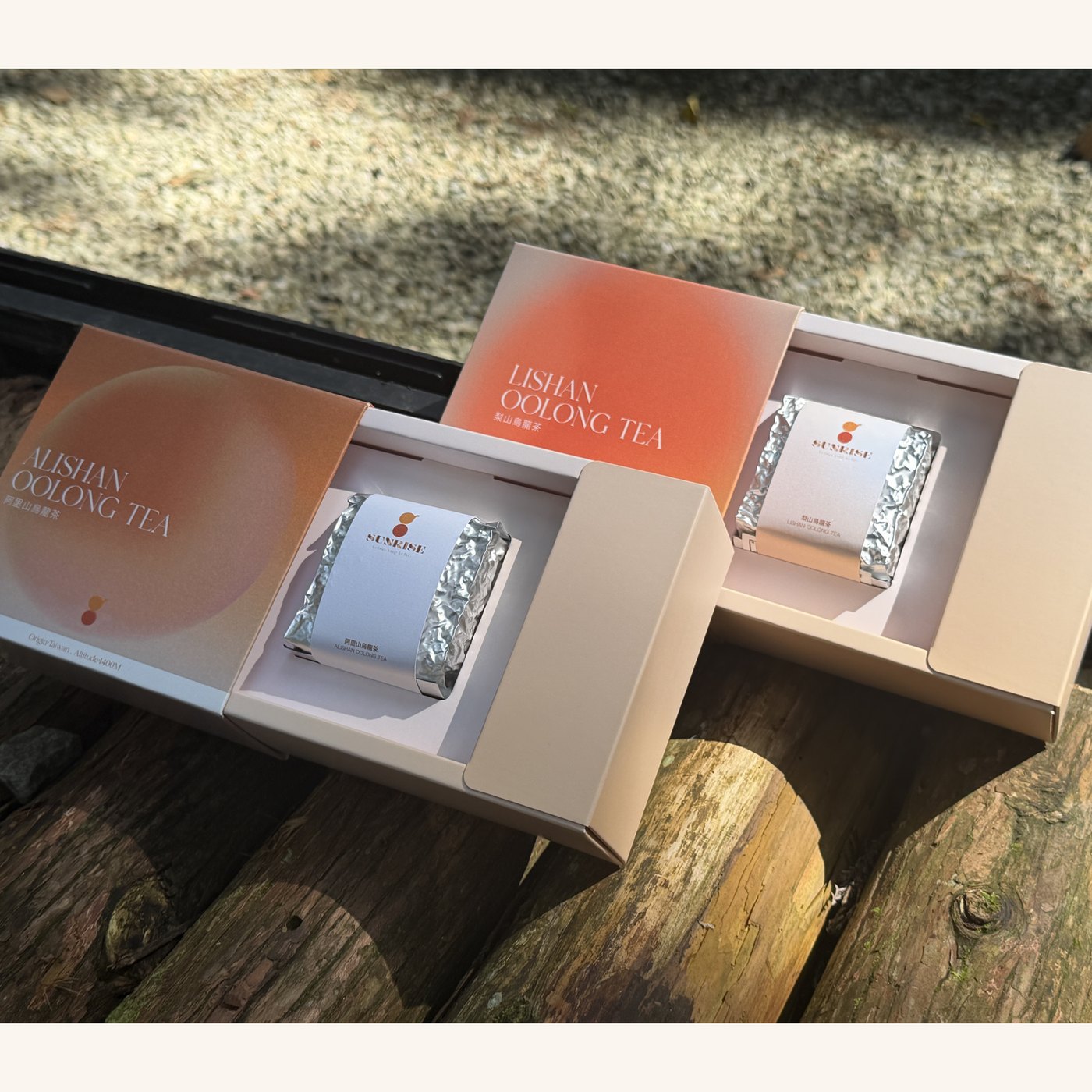
Four Seasons of a Mountain, Sealed and Handed to You
The hard part of giving isn't choosing. It's not knowing whether the thought will be seen.
Two things go wrong with gifts: the recipient has no use for it, or they can tell it was picked up along the way. Tea avoids both — almost everyone drinks it, it takes up no room in a cupboard, and it's ready the moment the box opens. But one tea differs greatly from another, and the difference is rarely on the outside of the box. It lies in where the tea came from, and whose hands looked after it.
It Begins on a Mountain
Our own gardens: Sunrise tea grows in our family's gardens in Lishan and Alishan — two thousand metres and fourteen hundred. Mist rolls through several times a day, and the swing between warm afternoons and cold nights lets the leaf grow slowly, and grow thick.
All of it, by us: from planting and hand-picking through withering, fixing, rolling and roasting, right up to the moment it goes into the box — all of it is ours, with no middleman in between. The tea also carries Taiwan's agricultural traceability certification: who grew it and where can be looked up.
Why that matters to you: it gives the giver something practical. When they ask where the tea is from, you can answer — not “a friend recommended it,” but a mountain with a name.
The One Who Watches Over It
My father has been making tea for over thirty years. Every batch that comes down the mountain, he still brews a pot himself and sits with it until the cup is empty, before deciding whether it goes out.
There is no timer to watch and no set of numbers to copy — only the judgement those thirty years left behind. Whether a box of tea tastes good usually gets decided on that quiet afternoon.
Two Mountains, Two Characters
Alishan, the gentler one: Alishan Misty Oolong grows between fourteen and sixteen hundred metres — bright floral aroma, soft on the palate, easy for anyone meeting high-mountain tea for the first time.
Lishan, the fuller one: Lishan Cloud-Peak sits above two thousand metres, growing slower and tasting deeper, with a finish that lingers. Regular tea drinkers notice it from the first sip.
So, which one: the choice stays simple — unsure of their taste, give both; for someone who loves deep, full-bodied flavours, give Lishan; for someone who loves bright and refreshing, give Alishan.
The Afternoon They Open It
A bag worth carrying: each gift box comes with a carry bag, so the moment you hand it over looks the way you meant it to.
A small brewing card: tea often sits unopened — not because people don't want it, but because they'd hate to spoil it. The card sets out water temperature, amount and timing, so the first pot can be brewed without worry.
A sense of size: brewing once a day, the smaller box keeps someone company for a fortnight; the larger sees out a month. For an elder who drinks daily, choose the larger. For a friend you see a few times a year, the smaller is exactly right.
Leave a Little Room in the Timing
On ordinary days: we dispatch one to three working days after payment, and delivery takes another two to four. A week is the unhurried allowance.
Around the festivals: at Mid-Autumn or Lunar New Year, every parcel in Taiwan is on the same road. Leave at least two weeks. The closer to the day, the less anyone can control.
A little earlier still: let the gift arrive a few days ahead, so they have time to open it and time to write back.
The Afternoon They Think of You
A box of tea isn't finished in one sitting. It waits quietly in the cupboard until some afternoon when they finally have time, and the kettle goes on. That's the quiet advantage of giving tea — the thought isn't only received, it gets slowly drunk. Pick a box out for them.